


- 16 Sep 2026
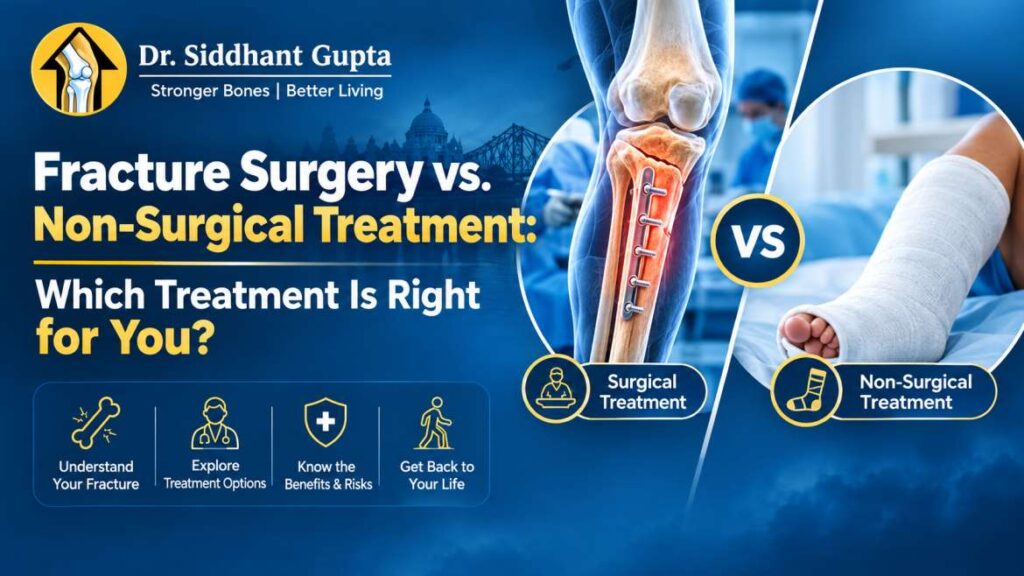
A bone fracture can be a painful and stressful experience, especially when you are unsure whether you need surgery. While some fractures heal with a cast, splint or brace, others may require surgical fixation to restore bone alignment and stability.
The right treatment depends on several factors, including the type of fracture, its location, alignment, severity and the patient’s overall health. There is no single treatment that is appropriate for every broken bone.
If you are looking for fracture treatment in Kolkata, an orthopaedic specialist can assess your injury and recommend an appropriate treatment plan based on clinical examination and imaging.
Understanding the difference between surgical and non-surgical fracture treatment can help you know what to expect during your recovery.
What Determines the Treatment for a Fracture?
Before deciding between surgery and non-surgical treatment, an orthopaedic doctor evaluates several factors.
These may include:
- Location of the fracture
- Type and severity of the fracture
- Whether the bone fragments are displaced
- Stability of the fracture
- Whether the fracture involves a joint
- Damage to surrounding soft tissues
- Patient’s age and general health
- Bone quality
- Activity level and functional requirements
X-rays are commonly used to assess fractures, while CT scans or other imaging may be required for more complex injuries.
The goal is not simply to join the broken bone but to achieve appropriate alignment and allow the patient to regain function.
What Is Non-Surgical Fracture Treatment?
Non-surgical fracture treatment, also called conservative fracture treatment, may be appropriate when the broken bone is stable and can heal in an acceptable position without an operation.
Casts and Splints
A cast or splint can immobilise the injured area and help prevent unnecessary movement while the bone heals.
Depending on the injury, a doctor may initially use a splint and later transition to a cast or brace.
Braces and Slings
Certain fractures may be managed using a brace or sling instead of a traditional cast. The choice depends on the affected bone and the stability of the fracture.
Follow-Up and Monitoring
Non-surgical treatment does not mean that no further medical care is required.
Follow-up appointments may be necessary to monitor whether the bone remains properly aligned and is healing as expected. Additional X-rays may be recommended during recovery.
Physiotherapy
After sufficient healing has occurred, physiotherapy may help restore movement, strength and function, particularly when prolonged immobilisation has caused stiffness or muscle weakness.
When Is Non-Surgical Treatment Usually Considered?
Non-surgical treatment may be considered when:
- The fracture is stable
- Bone fragments are properly aligned
- The fracture can maintain acceptable alignment
- The injury does not require surgical stabilisation
- The affected joint can function appropriately with conservative management
However, the suitability of non-surgical treatment must be determined individually.
Some fractures may initially be treated without surgery but require closer monitoring if the alignment changes during healing.
What Is Surgical Fracture Treatment?
Surgical fracture treatment involves realigning and stabilising the broken bone using an appropriate fixation technique.
This is often referred to as fracture fixation.
Depending on the fracture, an orthopaedic surgeon may use:
- Plates and screws
- Intramedullary nails
- Pins or wires
- External fixation devices
The choice depends on the location, pattern and complexity of the fracture.
When May Fracture Surgery Be Recommended?
Surgery may be considered when non-surgical treatment is unlikely to provide adequate alignment or stability.
Examples include:
Significantly Displaced Fractures
If the broken bone fragments have moved substantially out of their normal position, surgical fixation may be considered when satisfactory alignment cannot be maintained through non-surgical methods.
Unstable Fractures
Some fractures tend to shift even after the bones have been realigned. Surgical fixation can provide stability while the bone heals.
Joint-Involving Fractures
Fractures extending into a joint may require precise management to restore the joint surface and reduce the risk of long-term functional problems.
Open Fractures
An open fracture involves a wound associated with the broken bone. These injuries require urgent medical assessment because of the risk of infection and soft-tissue complications.
Multiple or Complex Fractures
When a bone is broken into several fragments, surgical treatment may be considered depending on the fracture pattern and whether the fragments can be appropriately stabilised.
Fracture Surgery vs Non-Surgical Treatment: Key Differences
Both approaches have an important role in fracture management.
| Factor | Non-Surgical Treatment | Surgical Treatment |
| Main approach | Immobilisation and monitoring | Realignment and fixation |
| Common methods | Cast, splint, brace, sling | Plates, screws, nails, pins |
| Suitable for | Stable and appropriately aligned fractures | Selected displaced, unstable or complex fractures |
| Hospital/surgical requirements | May not require surgery | Requires an operative procedure |
| Rehabilitation | May be needed after immobilisation | Usually includes post-operative rehabilitation |
This comparison does not mean that one approach is universally better than the other. The appropriate treatment depends on the individual fracture.
What Are the Advantages of Non-Surgical Treatment?
When appropriate, conservative fracture treatment avoids an operation and its associated surgical risks.
Potential advantages include:
- No surgical incision
- No anaesthesia required for the fracture treatment itself in many cases
- Lower exposure to certain surgical risks
- Treatment may be simpler for suitable fractures
However, non-surgical treatment still requires proper monitoring and follow-up.
What Are the Potential Benefits of Fracture Surgery?
For appropriately selected fractures, surgical fixation can provide stable alignment and may allow earlier controlled movement in certain cases.
Surgery can be particularly useful when maintaining alignment with a cast or brace is difficult.
However, surgery also has potential risks, such as infection, bleeding, blood clots, nerve or blood-vessel injury, anaesthesia-related complications and problems related to fixation devices. The risks vary according to the patient and procedure.
How Long Does Fracture Recovery Take?
There is no universal fracture recovery time.
Healing depends on factors such as:
- Type and location of the fracture
- Severity of the injury
- Patient’s age
- Bone health
- General health
- Smoking
- Nutrition
- Treatment method
- Rehabilitation
Some fractures may heal within several weeks, while complex fractures can take considerably longer.
Even after the bone has healed, restoring full strength and movement may require additional rehabilitation.
What Happens During Fracture Rehabilitation?
Rehabilitation is an important part of recovery after both surgical and non-surgical fracture treatment.
Depending on the injury, rehabilitation may involve:
- Gradual movement exercises
- Strengthening exercises
- Physiotherapy
- Progressive weight-bearing
- Functional exercises
- Gradual return to normal activities
The rehabilitation programme should be based on the fracture and stage of healing. Patients should avoid returning to strenuous activity too quickly.
Can a Fracture Treatment Change From Non-Surgical to Surgical?
In some cases, yes.
A fracture initially managed with a cast or brace may require surgery if follow-up imaging shows that the bone has shifted or is not healing as expected.
This is one reason why follow-up appointments are important. Treatment decisions can be reassessed as the fracture progresses.
When Should You Consult an Orthopaedic Doctor?
You should seek medical assessment after an injury if you experience:
- Severe pain
- Significant swelling
- Difficulty moving the affected limb
- Inability to bear weight
- Visible deformity
- Numbness or loss of sensation
- An open wound near the suspected fracture
- Significant bruising or tenderness
Urgent assessment is especially important after major trauma or when an open fracture or serious circulation problem is suspected.
Fracture Treatment in Kolkata
If you are searching for fracture treatment in Kolkata, the choice between surgery and non-surgical treatment should be made after a proper orthopaedic evaluation.
Dr. Siddhant Gupta provides orthopaedic care for fractures and trauma-related conditions, including fracture fixation when surgical stabilisation is appropriate.
Treatment is planned according to the patient’s fracture pattern, imaging findings, overall health and functional needs. A stable fracture may be managed conservatively, while a displaced or unstable fracture may require surgical fixation.
The objective is to select an appropriate treatment approach while supporting bone healing and restoration of function.
Frequently Asked Questions
Is surgery better than a cast for a fracture?
Not necessarily. Many fractures heal successfully with non-surgical treatment. Surgery is considered when it offers an appropriate way to restore or maintain alignment and stability.
Can a displaced fracture be treated without surgery?
Some displaced fractures can be realigned without surgery. However, if acceptable alignment cannot be achieved or maintained, surgical fixation may be recommended.
How long does a fracture take to heal without surgery?
Healing time varies depending on the fracture and the individual. Some fractures heal within several weeks, while others require longer.
Does fracture surgery speed up recovery?
In selected fractures, stable surgical fixation may allow earlier controlled movement. However, surgery does not guarantee faster overall healing, and recovery depends on many factors.
What is fracture fixation?
Fracture fixation is a surgical technique used to stabilise broken bone fragments. Depending on the injury, plates, screws, nails, pins or other devices may be used.
Conclusion
Both surgical and non-surgical treatments have an important role in fracture management. A stable, well-aligned fracture may often be treated with a cast, splint or brace, while displaced, unstable, open or complex fractures may require surgical fixation.
The right treatment cannot be determined by the word “fracture” alone. An orthopaedic assessment, appropriate imaging and consideration of the patient’s overall health are important before deciding on a treatment approach.
If you have sustained an injury and suspect a broken bone, timely evaluation can help determine the most suitable treatment and recovery plan. Patients seeking fracture treatment in Kolkata can consult Dr. Siddhant Gupta for an appropriate orthopaedic assessment and treatment plan.