

- 22 Oct 2026
Persistent knee pain, swelling, clicking, or difficulty bending your leg can interfere with everyday activities. Whether you experience discomfort while walking, climbing stairs, or playing sports, identifying the cause is essential for choosing the right treatment. In certain cases, when nonsurgical treatments do not provide sufficient relief, knee arthroscopy may be considered.
If you are searching for an arthroscopy surgeon in Kolkata, understanding the procedure, its potential benefits, risks, and recovery time can help you make an informed decision. This guide explains when knee arthroscopy may be necessary, how the procedure works, and what you can expect during recovery.
What Is Knee Arthroscopy?
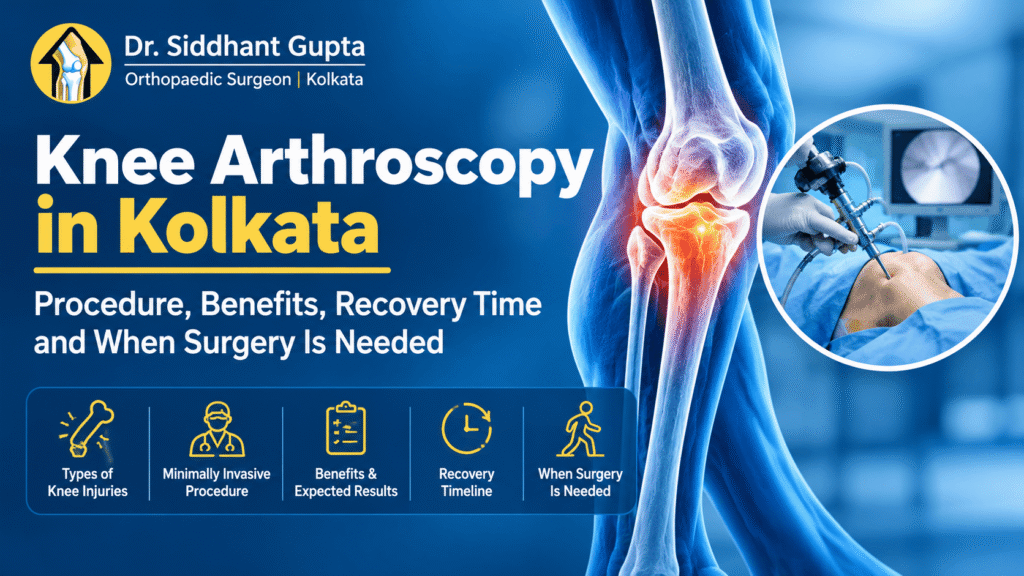
Knee arthroscopy is a minimally invasive surgical procedure used to examine and treat certain problems inside the knee joint. During the procedure, an orthopaedic surgeon inserts a small camera, called an arthroscope, through a small incision. The camera displays images of the inside of the joint on a monitor, allowing the surgeon to examine the affected structures and use specialised instruments to treat suitable conditions.
Compared with conventional open surgery, arthroscopy generally requires smaller incisions. However, the suitability of the procedure depends on the type of injury, the extent of joint damage, and the patient’s overall health.
An experienced arthroscopy surgeon in Kolkata can assess your symptoms, examination findings, and imaging results to determine whether knee arthroscopy may be appropriate for your condition.
When Is Knee Arthroscopy Needed?
Knee arthroscopy may be recommended when a specific problem inside the knee joint causes persistent symptoms and is likely to benefit from surgical treatment. However, not every knee injury or instance of knee pain requires surgery.
Some conditions that may be treated using knee arthroscopy include the following.
1. Meniscus Tears
The menisci are two crescent-shaped pieces of cartilage that help cushion the knee joint and distribute pressure. A sudden twisting movement, sports injury, or age-related degeneration can cause a meniscus tear.
Common symptoms include knee pain, swelling, stiffness, catching, and difficulty bending or straightening the leg. Depending on the tear’s location, pattern, and severity, treatment may involve physiotherapy, meniscus repair, or removal of a limited amount of damaged tissue.
2. ACL and Other Ligament Injuries
The anterior cruciate ligament (ACL) helps stabilise the knee during movements such as turning, pivoting, and changing direction. An ACL injury can occur during sports or following a sudden twisting movement.
Some ligament injuries can be managed with rehabilitation and activity modification. However, patients with significant instability or specific functional requirements may benefit from surgical reconstruction. Arthroscopy is commonly used during ACL reconstruction.
3. Cartilage Damage and Loose Fragments
Damage to the cartilage inside the knee or loose fragments of bone or cartilage may cause discomfort, catching, or restricted movement. In selected cases, an arthroscopic procedure can help address the underlying problem.
The appropriate treatment depends on the location and extent of the damage. Knee arthroscopy does not reverse all cartilage degeneration, and patients with osteoarthritis may require other treatment approaches.
4. Persistent Knee Locking or Catching
Repeated episodes of knee locking or catching may indicate a mechanical problem inside the joint, such as a displaced meniscus tear or a loose fragment.
An orthopaedic assessment is important to identify the cause. Clicking alone does not necessarily indicate a serious injury or mean that surgery is required.
When Can Knee Pain Be Treated Without Surgery?
Many knee problems improve with conservative treatment, including physiotherapy, activity modification, appropriate medication, and guided exercise.
Arthroscopy is generally not recommended solely to treat uncomplicated knee osteoarthritis when there is no specific indication for the procedure. A careful assessment helps determine whether surgery is likely to provide meaningful benefits.
How Is Knee Arthroscopy Performed?
The exact procedure depends on the condition being treated. However, knee arthroscopy usually involves the following steps.
Step 1: Clinical Assessment and Investigations
The surgeon reviews your symptoms, medical history, previous injuries, and physical examination findings. Depending on the suspected condition, X-rays or an MRI may be recommended to assess the bones, menisci, ligaments, and other joint structures.
Step 2: Anaesthesia and Preparation
Knee arthroscopy is performed under an appropriate form of anaesthesia, commonly regional or general anaesthesia. The choice depends on the patient’s health, the planned procedure, and the clinical team’s assessment.
Step 3: Small Incisions and Joint Examination
The surgeon makes small incisions around the knee to introduce the arthroscope and specialised instruments. The camera provides a magnified view of the internal structures, helping the surgeon assess the affected area.
Step 4: Treating the Knee Problem
Depending on the diagnosis, the surgeon may repair a torn meniscus, reconstruct a ligament, remove selected loose fragments, or perform another appropriate arthroscopic procedure.
Step 5: Postoperative Care
After surgery, the patient is monitored while recovering from anaesthesia. The medical team provides instructions about wound care, pain management, mobility, and rehabilitation.
Many arthroscopic procedures can be performed as day-care operations, although more complex surgery or individual medical needs may require a different arrangement.
What Are the Benefits of Knee Arthroscopy?
For appropriately selected patients, knee arthroscopy may offer several advantages.
- Smaller incisions: The procedure generally requires smaller cuts than conventional open surgery.
- Targeted treatment: Specialised instruments allow the surgeon to address certain problems inside the joint.
- Potentially easier early recovery: Some patients experience less disruption to surrounding soft tissues compared with more extensive surgical approaches.
- Treatment of specific injuries: Selected meniscus tears, ligament injuries, and loose joint fragments can be treated arthroscopically.
- Improved function: When the underlying problem is appropriately treated and rehabilitation is completed, patients may regain movement, stability, and confidence in using the knee.
However, these benefits are not guaranteed. Outcomes depend on the underlying condition, the extent of damage, the procedure performed, and the patient’s rehabilitation progress.
Knee arthroscopy cannot guarantee complete pain relief or reverse all forms of joint degeneration. Before proceeding, discuss the expected benefits, possible limitations, and available alternatives with your surgeon.
Knee Arthroscopy Recovery Time: What Should You Expect?
Knee arthroscopy recovery time varies according to the condition being treated and the type of procedure performed. Recovery after a relatively minor procedure may take a few weeks, whereas meniscus repair or ACL reconstruction can require several months of rehabilitation.
First Few Days After Surgery
Some pain, swelling, and stiffness are common during the initial recovery period. Your surgeon may recommend prescribed medication, ice packs wrapped in a cloth, leg elevation, and appropriate wound care.
Crutches or other walking support may be necessary. Follow the instructions provided about weight-bearing, knee movement, and wound protection.
First Two to Six Weeks
During this period, many patients gradually improve their knee movement, walking ability, and muscle strength. A physiotherapist may recommend exercises to restore mobility and strengthen the muscles supporting the knee.
The recovery plan depends on the procedure. Patients who undergo meniscus repair or ligament reconstruction may need additional precautions and a more structured rehabilitation programme.
Returning to Work, Exercise, and Sports
Some patients can return to desk-based work or light daily activities within days or a few weeks after a relatively minor arthroscopic procedure. More demanding work, running, jumping, and competitive sports may require substantially longer.
Your return to activity should depend on pain, swelling, strength, stability, movement, and the nature of the original injury. Follow your surgeon’s and physiotherapist’s advice rather than relying only on the time elapsed since surgery.
What Are the Risks and Complications of Knee Arthroscopy?
Knee arthroscopy is commonly performed, but like any surgical procedure, it carries potential risks. These include:
- Infection around the joint or surgical incisions
- Bleeding or fluid accumulation in the knee
- Persistent pain, swelling, or stiffness
- Blood clots in the leg
- Reactions to anaesthesia
- Rare injury to nearby nerves or blood vessels
The likelihood of complications varies according to the patient’s health and the type of procedure. Following postoperative instructions and attending scheduled follow-up appointments can help identify potential problems early.
Contact your treating team promptly if you experience fever, increasing redness, wound discharge, severe or worsening pain, or unusual swelling. Chest pain or sudden shortness of breath requires emergency medical attention.
How to Choose an Arthroscopy Surgeon in Kolkata
Choosing the right specialist is an important step when considering knee surgery. If you are looking for an arthroscopy surgeon in Kolkata, consider the following factors before making a decision.
Relevant Orthopaedic Expertise
Look for an orthopaedic surgeon with appropriate training and experience in arthroscopy and the specific knee condition requiring treatment.Accurate Diagnosis and Treatment Planning
Your surgeon should explain the suspected injury, investigation findings, and available treatment options. Understanding the diagnosis helps you make an informed decision about your care.
Discussion of Nonsurgical Alternatives
Ask whether physiotherapy, medication, activity modification, or other conservative approaches may be suitable. Surgery should be considered when the likely benefits justify the risks and alternatives.
Rehabilitation and Follow-Up
Recovery does not end when the procedure is completed. A clear rehabilitation plan, appropriate follow-up, and guidance on returning to work or sports are important parts of treatment.
Patients seeking knee arthroscopy in Kolkata should prioritise clear communication, an individualised treatment plan, and realistic expectations about recovery.
Consult Dr. Siddhant Gupta for Knee Assessment in Kolkata
Persistent knee pain, recurring swelling, instability, or difficulty moving your knee deserves proper evaluation, particularly when symptoms interfere with everyday activities.
If you are exploring treatment options for a knee injury, visit Dr. Siddhant Gupta’s orthopaedic website to learn more about the practice and available consultation information.
An individual assessment can help you understand your condition, discuss whether knee arthroscopy may be appropriate, and explore a treatment plan based on your needs.
Frequently Asked Questions About Knee Arthroscopy
1. Is knee arthroscopy a major surgery?
Knee arthroscopy is generally less invasive than open knee surgery because it uses small incisions. However, the complexity depends on the procedure performed. Meniscus repair and ACL reconstruction typically require more extensive rehabilitation than some simpler arthroscopic procedures.
2. How long does knee arthroscopy take?
The duration depends on the condition and the treatment required. Some procedures take less than an hour, while more complex operations may take longer. Your surgeon can provide a more accurate estimate based on the planned procedure.
3. Can I walk immediately after knee arthroscopy?
Some patients can walk with support soon after a relatively minor procedure. Others may need crutches and restrictions on weight-bearing, particularly after meniscus repair or ligament reconstruction. Always follow your surgeon’s instructions.
4. Is knee arthroscopy painful?
Some pain and swelling are normal after surgery. Anaesthesia and prescribed pain-relief measures help manage discomfort, while rehabilitation supports recovery. The level of pain varies depending on the procedure and the individual.
5. Can a meniscus tear heal without surgery?
Some meniscus tears can improve with nonsurgical treatment, depending on the tear’s characteristics and the patient’s symptoms. Other tears may benefit from surgical repair or another procedure. An orthopaedic assessment helps determine the appropriate approach.
6. When should I consult an arthroscopy surgeon in Kolkata?
Consider an orthopaedic assessment if knee pain persists, swelling repeatedly returns, the knee feels unstable, or movement remains restricted despite appropriate initial treatment. Seek urgent medical attention if you cannot bear weight after a significant injury, the knee appears deformed, or it becomes hot and swollen with fever.
Medical Disclaimer: This article is intended for general educational purposes and does not replace professional medical advice, diagnosis, or treatment. Consult a qualified healthcare professional for an assessment of your individual condition.